Buck's Battle with Spitz
The Call of the WildBuck's Battle with Spitz is the decisive struggle through which Buck replaces Spitz as leader of the sled team. The fight is not an isolated quarrel but the culmination of Buck's adaptation to the Northland: he has learned the law of club and fang, discovered the pride of trace and trail, and developed the patience to challenge an established master at the right moment. When Spitz disappears beneath the moonlit snow, Buck emerges not merely as the survivor but as the dominant force around which the team must be reorganized.
Causes and Rivalry
The contest grows from a structural conflict between two claims to authority. Spitz is the acknowledged lead-dog and master of the team, while Buck increasingly possesses the strength, cunning, endurance, and judgment required to replace him. Francois recognizes the danger before the fight, predicting that Buck will someday become angry enough to tear Spitz apart. Spitz likewise fears Buck as a possible lead-dog because Buck alone among the Southland dogs has endured and prospered under frost, starvation, and labor. Buck's earlier experience of Curly's death has taught him that a fallen dog receives no mercy; his intervention against Spitz's punishment of Pike therefore becomes an open threat to the established order. Buck repeatedly places himself between Spitz and dogs who have shirked, especially when Pike is unearthed from beneath the snow. Francois beats Buck with the whip and butt of the whip, but the punishment does not remove his hostility or his ambition.
The deeper motive is the pride of trace and trail. Harness work transforms Dave and Solleks from passive, irritable animals into alert, purposeful workers, and Buck comes to share that fierce satisfaction in doing the work well. For Spitz, this pride means enforcing discipline and defending his position; for Buck, it becomes the impulse to claim the position himself. His rebellion spreads disorder through the team, while he remains careful enough to avoid being caught openly by Francois. The leadership struggle is thus both personal and functional: it concerns dominance between two dogs, but also who can impose order, make judgments, and direct collective labor.
The Chase and Opening Clash
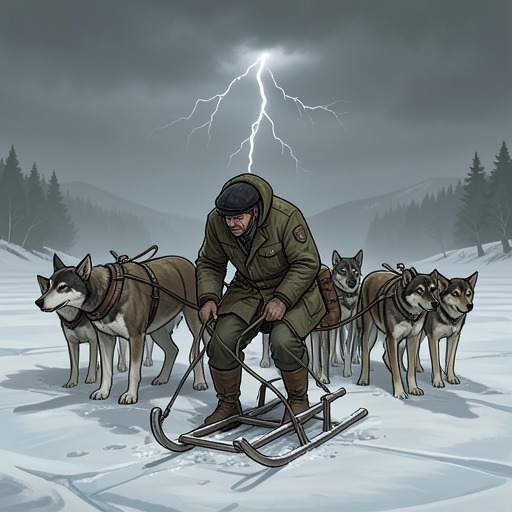
The immediate occasion arrives at the mouth of the Tahkeena, when Dub startles a snowshoe hare. The entire team joins the pursuit, and fifty huskies from a nearby Northwest Police camp swell the chase until the pack numbers sixty. The rabbit runs lightly across the snow while the dogs labor through it, and Buck takes the lead, driven by an intense hunting instinct. He experiences the pursuit as a complete physical absorption in movement and living prey, straining through the wan moonlight to seize the animal with his own teeth.
Spitz abandons the direct line and cuts across a narrow neck of land where the creek bends. He reaches the rabbit first, leaping from an overhanging bank and breaking its back in mid-air. The rabbit's shriek becomes the signal for the larger confrontation. Buck does not hesitate or check his rush; he drives into Spitz shoulder to shoulder, though the impact misses the throat. The two dogs roll through the powdery snow, and Spitz rises quickly, slashing Buck's shoulder before leaping clear. Their conflict has now become a death match witnessed by the entire pack.
The Fight to the Death
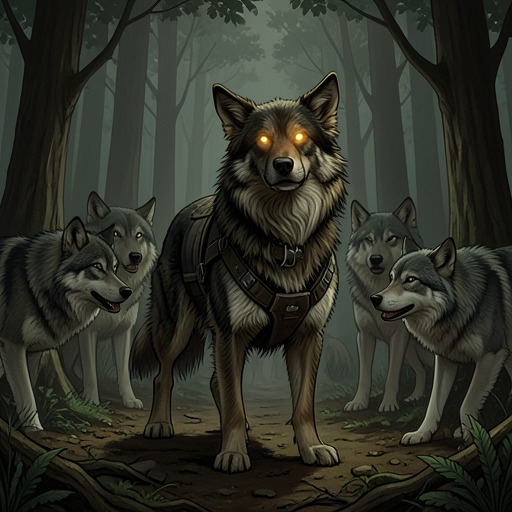
The dogs form a silent, expectant circle. The stillness of the white woods, the moonlight, and the drifting breath of the huskies make the encounter seem ancient to Buck, as though this confrontation belongs to an older order than the camp and its human rules. The surrounding dogs have already learned the consequence of weakness. They wait to close upon whichever combatant falls, reproducing the same merciless pattern Buck witnessed when Curly was pulled down and buried beneath attacking huskies.
Spitz's skill makes him a formidable opponent. He has fought dogs across the Arctic and Canada and never attacks without preparing to defend the counterattack. Buck repeatedly aims for the white throat, but Spitz meets each attempt with his own fangs and escapes lightly. Buck's lips are cut, his shoulder is slashed, and blood streams from him while Spitz remains untouched. When Buck tries to overthrow him with a shoulder blow, Spitz anticipates the movement and cuts him again. As Buck tires and staggers, the waiting circle stirs; once he falls, the sixty dogs rise together, ready to finish the defeated animal. Buck recovers in mid-air, but the danger confirms that there will be no second chance.
Buck wins through imagination as well as force. He repeats the shoulder feint, then drops low at the last instant and seizes Spitz's left foreleg. The crunch of breaking bone leaves Spitz facing him on three legs. When Spitz still struggles to remain upright, Buck repeats the maneuver and breaks the right foreleg as well. The injured leader sees the silent circle closing around him, a fate he has previously imposed on defeated rivals. Buck then maneuvers for the final rush. As Spitz quivers and snarls, Buck springs in and out; this time his shoulder meets Spitz's squarely. Spitz disappears into the dark mass of the pack, and Buck remains standing as the successful champion who has made his kill.
Consequences for the Team
The next morning Francois finds Spitz missing and Buck covered with wounds. The men recognize the result, but the first attempt to assign leadership still produces resistance. Buck trots to the place Spitz occupied, yet Francois puts Solleks there, judging him the best remaining lead-dog. Buck attacks Solleks and takes the position by force. Francois tries to call him away, but Buck keeps his distance until Perrault orders the dog-driver to throw down the club. Once the club is removed, Buck returns triumphantly, swings into the front position, and allows his traces to be fastened.
Buck's authority proves practical rather than merely ceremonial. He immediately assumes the duties of leadership, showing superior judgment, quick thinking, and quick action even when compared with Spitz. Dave and Solleks accept the change because their concern is the work itself; as long as they can toil in the traces, leadership is not their affair. The less disciplined dogs, however, must be forcibly retrained. Buck shakes Pike repeatedly for loafing, and by the end of the first day Pike is pulling harder than ever. He overpowers Joe, who had resisted Spitz's discipline, until Joe stops snapping and begins to whine. The team quickly regains its solidarity and again moves as one animal in the traces. Buck also breaks in the newly added native huskies Teek and Koona with a speed that astonishes Francois.
Meaning and Long-Term Significance
The victory marks a change from inherited authority to earned functional mastery. Spitz has ruled through experience, aggression, and punishment; Buck combines those qualities with endurance, strategic intelligence, and an ability to restore collective discipline. The event therefore reveals that leadership in the Northland is not secured by title alone. It must be continually demonstrated in danger, work, and the management of other animals.
The fight also completes a transformation begun by Buck's abduction and training. The Southland dog who once found the harness humiliating has learned to take pride in labor and to understand the brutal social code surrounding it. His triumph over Spitz is the point at which the old domestic identity can no longer govern him. Later, when he confronts a wolf pack, kills a charging wolf, and finally joins the pack beside his wild brother, the earlier victory appears as a threshold: Buck has first mastered the sled team, then moves toward a life in which human claims no longer bind him. Yet the immediate consequence remains concrete and communal. After Spitz's death, Buck turns conflict into order, and the team becomes faster, more disciplined, and more unified under his command.